
Resources
We publish research, tools, and lessons learned to help healthcare and legal organizations build and operate medical-legal partnerships and to help funders and policymakers advance medical-legal partnership activities. You can search those resources in the library below.
The library also links to journal articles, authored both by National Center for Medical-Legal Partnership staff and MLP practitioners and researchers from the field, that highlight ways medical-legal partnerships have improved patient health and well-being, the healthcare workforce, and healthcare delivery. A list of these articles with summaries are also available on the Peer-Reviewed Research page.
Medical-Legal Partnerships Facilitate Patient-Provider Cost of Care Conversations: A Multisite Qualitative Study in the U.S.
This study, based on interviews with medical-legal partnership personnel in 10 states, found that having legal staff on-site built healthcare providers’ confidence around addressing health-harming legal needs through effective cost of care conversations, improved patient outcomes, and increased return on investment for health systems. Findings were published in Clinical Nursing Research.
Better Together: A Descriptive Analysis of a Medical-Legal Partnership in Western North Carolina
The study describes the impact of a medical-legal partnership (MLP) between Pisgah Legal Services and the Mountain Area Health Education Center, which serves rural North Carolina counties, over a 24-month period. The MLP was successful in helping to address multiple social needs faced by patients that contribute to worse health status and outcomes. Monetary benefits to patients were $309,902 plus an additional $174,733 from tax returns and the Earned Income Tax Credit. The findings were published in the North Carolina Medical Journal.
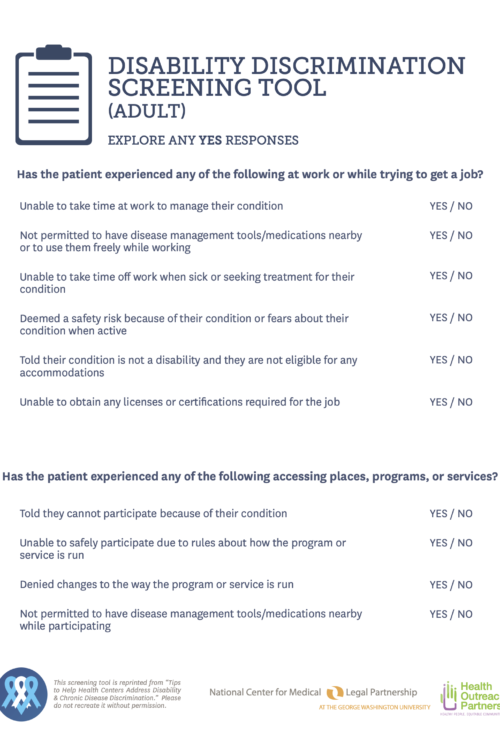
Screening Tool for Disability Discrimination
Two new screening tools help healthcare providers determine if a patient is experiencing discrimination based on a disability or chronic disease. There is one tool for adults and another for children and young adults (including those attending college).
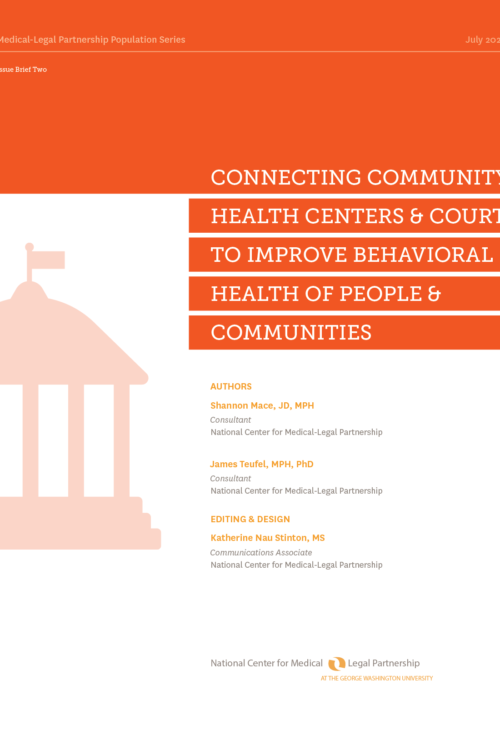
Connecting Community Health Centers & Courts to Improve Behavioral Health of People & Communities
As an exploration of the intersection of health and justice, this issue brief offers nine recommendations of how health centers and courts can better support the behavioral health of justice-involved people. It proposes ways in which these organizations can collaborate and ultimately foster the next phase of the medical-legal partnership movement, bringing the healthcare provider into the legal context and expanding the pool of potential legal services providers.

Tips to Help Health Centers Address Disability & Chronic Disease Discrimination
This resource contains tips, electronic resources, and two brand new screening tools for health centers to help their patients with disabilities and chronic diseases. It covers topics such as employment, immigration, education, and Long COVID.
Improving Health Outcomes in Vulnerable Populations: The Medical-Legal Partnership-Colorado's Experience
The study evaluated the impact on health outcomes and health care utilization of a MLP housed in a large federally qualified health center in Colorado (MLP-CO). Clients screened for I-HELP™ needs were surveyed at baseline and six months post-enrollment. Overall, 61.4% attributed great/moderate improvements in their health care experience to the MLP-CO.