
Resources
We publish research, tools, and lessons learned to help healthcare and legal organizations build and operate medical-legal partnerships and to help funders and policymakers advance medical-legal partnership activities. You can search those resources in the library below.
The library also links to journal articles, authored both by National Center for Medical-Legal Partnership staff and MLP practitioners and researchers from the field, that highlight ways medical-legal partnerships have improved patient health and well-being, the healthcare workforce, and healthcare delivery. A list of these articles with summaries are also available on the Peer-Reviewed Research page.
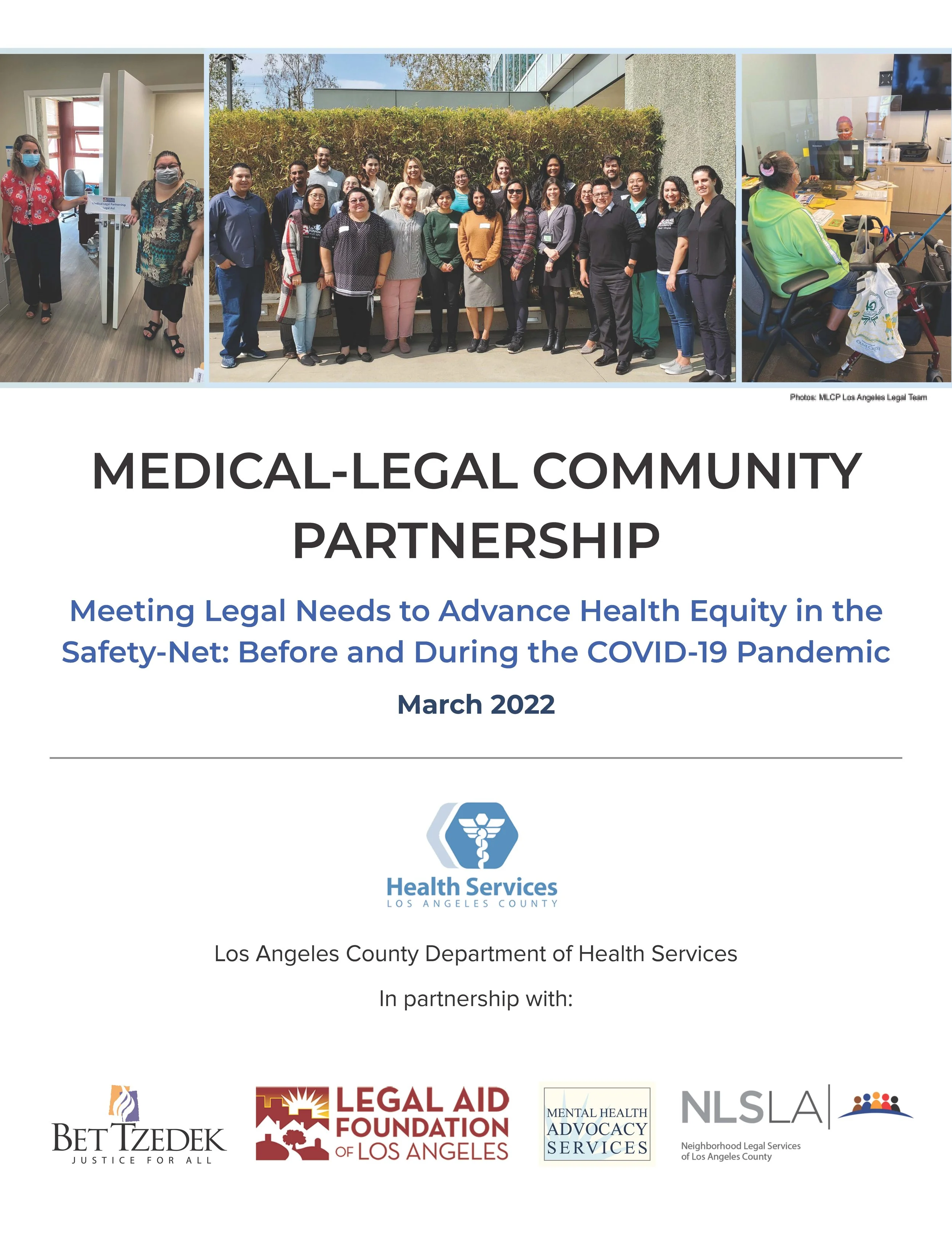
Sample MLP Impact Report from the Medical-Legal Community Partnership in Los Angeles
Launched in 2018, the Medical-Legal Community Partnership (MLCP) is an initiative of the Los Angeles County Department of Health Services that provides no-cost civil legal assistance to patients. This March 2022 Impact Report shares MLCP’s key achievements since its inception, especially to meet the unique demands of the COVID-19 pandemic. It includes the services that MLCP provides, the impact and outcomes of those services, and lessons learned by the partners. This sample impact report can serve as an example for other medical-legal partnerships about how to share their impact with partners and stakeholders.
The Impact of a Pediatric Medical-Legal Partnership on Pediatric Providers: A Qualitative Study
Authors conducted semi-structured interviews with 20 pediatric providers and 20 parents/guardians who had engaged with medical-legal partnership services at an academic medical center in New Haven, Connecticut. They found that the MLP improved provider knowledge of and ability to address social determinants of health and health-harming legal needs, improved provider-family relationships, and encouraged providers to engage in systemic and institutional advocacy. Findings were published in Academic Pediatrics.
Reductions In Hospitalizations Among Children Referred To A Primary Care–Based Medical-Legal Partnership
A study conducted in Greater Cincinnati, Ohio, between 2012 and 2017 examined the effect of referral to a medical-legal partnership on hospitalization rates among urban, low-income children. Researchers found that the median predicted hospitalization rate for children in the year after referral was 37.9 percent lower if children received the legal intervention than if they did not. The research was published in Health Affairs.
Reducing Asthma Exacerbations in Vulnerable Children Through a Medical–Legal Partnership
The study examines whether a medical-legal partnership (MLP) could impact asthma exacerbation rates in a vulnerable urban population at an academic children’s hospital. In a pediatric population with asthma, an MLP intervention was associated with a significant reduction in asthma exacerbation encounters and hospitalizations comparing the year before and after MLP intervention. The findings were published in the Journal of Asthma.
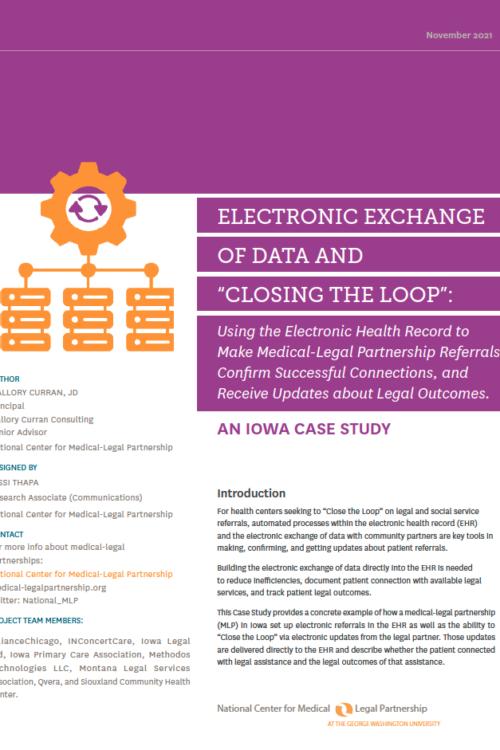
Electronic Exchange of Data and “Closing The Loop”: An Iowa Case Study
This case study provides a concrete example of how a medical-legal partnership (MLP) in Iowa set up electronic referrals in the electronic health record (EHR) as well as the ability to “close the loop” via electronic updates from the legal partner. Those updates are delivered directly to the EHR and describe whether the patient is connected with legal assistance and the legal outcomes of that assistance.
Teaching the Social Determinants of Health through Medical-Legal Partnerships: A Systematic Review
The authors conducted a systematic review to better define the impact that educational programs centered on medical-legal partnerships have on trainees’ knowledge, attitudes and future practice with regards to the social determinants of health. Benefits to trainees were wide in scope but all programs showed improvements in participants’ understanding, comfort, confidence, and/or abilities in identifying and intervening on the social determinants of health in their patients. This article was published in the BMC Medical Education.