
Resources
We publish research, tools, and lessons learned to help healthcare and legal organizations build and operate medical-legal partnerships and to help funders and policymakers advance medical-legal partnership activities. You can search those resources in the library below.
The library also links to journal articles, authored both by National Center for Medical-Legal Partnership staff and MLP practitioners and researchers from the field, that highlight ways medical-legal partnerships have improved patient health and well-being, the healthcare workforce, and healthcare delivery. A list of these articles with summaries are also available on the Peer-Reviewed Research page.
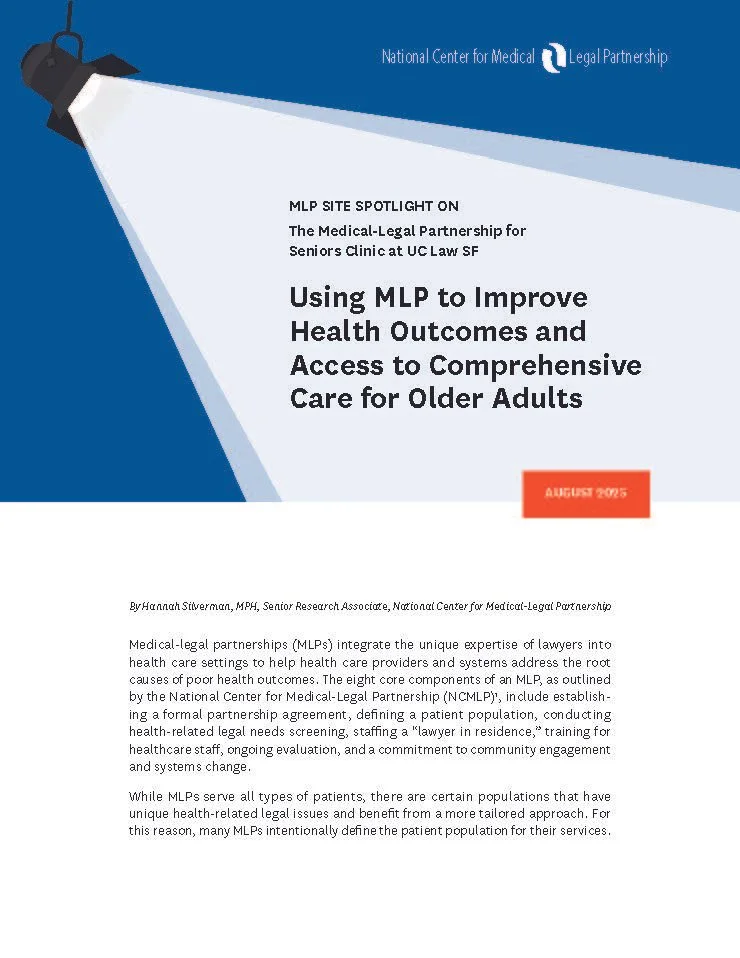
Using MLP to Improve Health Outcomes and Access to Comprehensive Care for Older Adults
This site profile features the work of the Medical-Legal Partnership for Seniors (MLPS) Clinic. MLPS provides comprehensive legal support to older adults in San Francisco who face complex, overlapping issues related to health, housing, income, and planning for future care. Led by Sarah Hooper, JD, the clinic serves a high-need population that is often socially isolated and at risk of institutionalization, with many living below the poverty line. This MLP also trains future healthcare and legal professionals to work collaboratively in addressing the unique legal needs of aging patients and their caregivers. The profile details how, through early screening, advanced care planning, and community partnerships, MLPS helps improve both the health and quality of life for older adults.
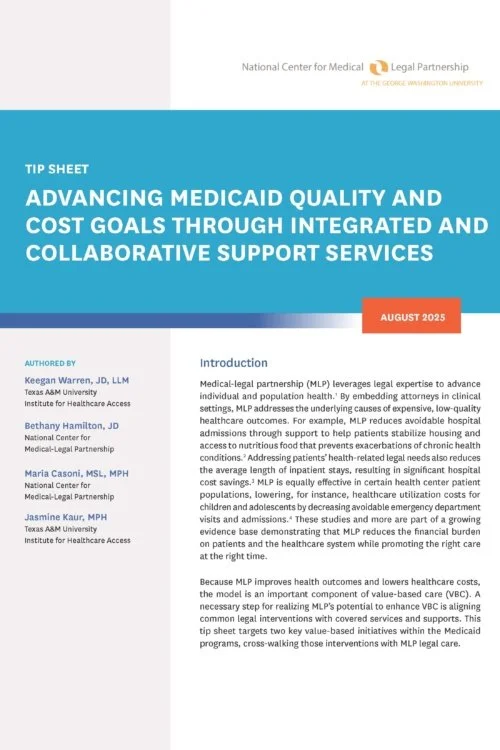
Advancing Medicaid Quality And Cost Goals Through Integrated And Collaborative Support Services
The National Center for Medical-Legal Partnership and Texas A&M’s Institute for Healthcare Access have released a new HRSA and Kaiser Permanente-supported tip sheet showing how MLP interventions can align with Medicaid to address patients’ health-related social needs. The resource offers strategies for integrating legal services into value-based care and highlights examples like North Carolina’s Healthy Opportunities Pilot.
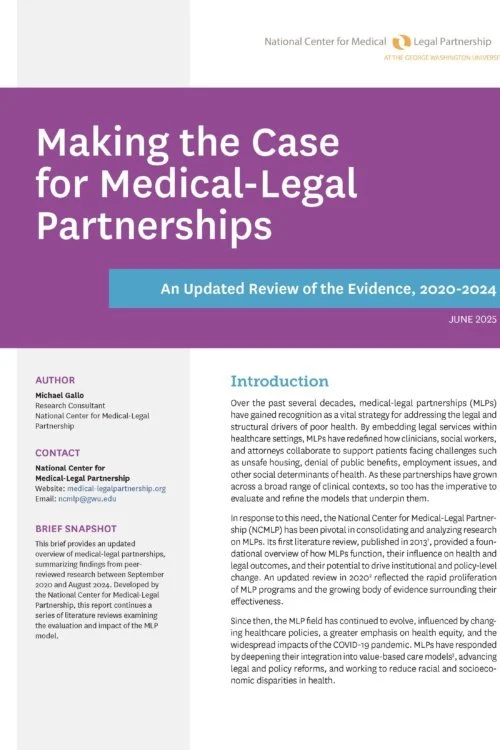
Making the Case for Medical-Legal Partnerships: A Review of the Evidence
The National Center for Medical-Legal Partnership has published three comprehensive literature reviews that offer an in-depth analysis of peer-reviewed research on medical-legal partnerships (MLPs). They capture the evolution and growing impact of MLPs across healthcare systems from 1977 - 2024.
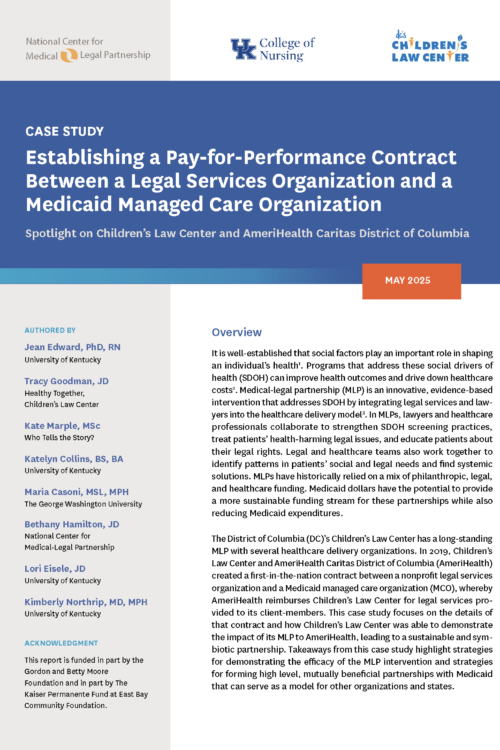
Establishing a Pay-for-Performance Contract Between a Legal Services Organization and a Medicaid Managed Care Organization
In Washington, D.C., Children’s Law Center partnered with AmeriHealth Caritas DC to establish a reimbursement model for legal services delivered to Medicaid enrollees. This case study explores how the medical-legal partnership (MLP) demonstrated its value, the data strategies that supported the partnership, and how the model can be replicated in other states.
Feasibility of Medical-Legal Partnership to Improve Inpatient Outcomes and Reduce Hospital Length of Stay
This article published in the Journal of Health Care for the Poor and Underserved reports on a study of 110 adult patients admitted to a safety-net public hospital beyond medically predicted length of stay. Each adult was assessed for health-harming legal needs and referred for MLP legal services if indicated. The assessment found that lack of guardianship was specifically associated with increased excess length of stay. Over a one year period, the MLP was able to reduce length of stay for some patients and cost-analysis showed savings in excess of $200,000.
Health, Housing, and Justice: Two-Year Implementation Evaluation of a Health System's Multi-State Medical-Legal Partnership to Address Housing Instability
A two-year evaluation of Kaiser Permanente’s (KP) multi-state medical-legal partnership sheds light on how healthcare and legal sectors can work together to address housing instability and what it takes to implement these partnerships effectively at scale. The findings, published in Health Services Research, reveal that the MLP expanded access to legal services and delivered services efficiently. Eighty-two percent of legal cases were resolved with fewer than five hours of attorney time.