
Resources
We publish research, tools, and lessons learned to help healthcare and legal organizations build and operate medical-legal partnerships and to help funders and policymakers advance medical-legal partnership activities. You can search those resources in the library below.
The library also links to journal articles, authored both by National Center for Medical-Legal Partnership staff and MLP practitioners and researchers from the field, that highlight ways medical-legal partnerships have improved patient health and well-being, the healthcare workforce, and healthcare delivery. A list of these articles with summaries are also available on the Peer-Reviewed Research page.
Medical-Legal Partnership LegalServer Configuration Guide
To help civil legal aid programs document and describe their crucial contributions to the health of their communities, this guide offers step-by-step instructions on how to collect health and healthcare data in LegalServer, a case management system used by many civil legal aid organizations. The guide walks through how to configure LegalServer with medical-legal partnership fields.
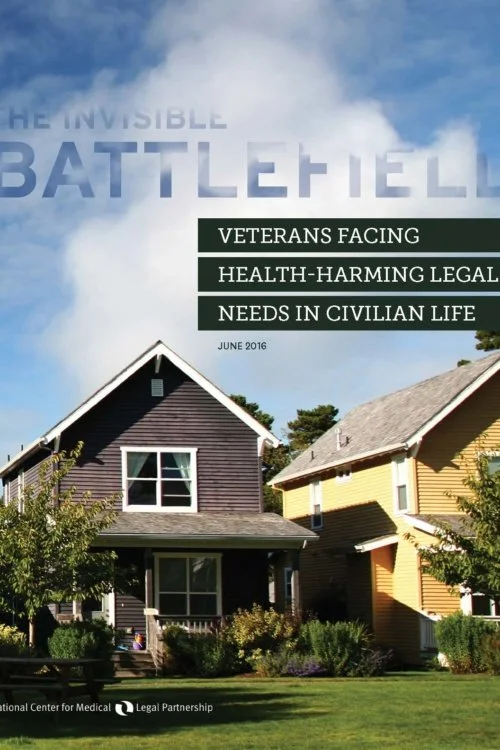
The Invisible Battlefield: Veterans Facing Health-Harming Legal Needs in Civilian Life
This issue brief discusses how medical-legal partnerships (MLPs) are poised to help address the unmet legal needs of veterans by integrating civil legal aid services into existing healthcare services for veterans. MLPs break down the silos between legal stakeholders and the healthcare team to address veteran access to: healthy housing, VA benefits, an honorable military discharge status, and employment. While many veterans still face invisible battlefields in their civilian lives and lack support for their complex legal needs, MLPs for veterans are growing in number and expertise — showing great promise for both confronting and preventing veterans’ legal barriers to health and well-being.
‘Extra Oomph:’ Addressing Housing Disparities Through Medical-Legal Partnership Interventions
Drawn from in-depth interviews with 72 patients, this study investigated the outcomes of medical-legal partnership (MLP) interventions and compared results to similarly disadvantaged participants with no access to MLP services. Results indicate that participants in the MLP group were more likely to achieve adequate, affordable, and stable housing than those in the comparison group. Study findings suggest that providing access to legal services in the healthcare setting can effectively address widespread health disparities rooted in problematic housing.

NCMLP Performance Measures Handbook
The National Center for Medical-Legal Partnership is engaged in efforts to develop, implement, and test medical-legal partnership (MLP) performance measures. This handbook offers a detailed accounting of seven initial measures and how to use them. The measures cover MLP training, screening, referrals, and outcomes.
Tax-Exempt Hospitals and Community Health Under the Affordable Care Act: Identifying and Addressing Unmet Legal Needs as Social Determinants of Health
This article reviews recently promulgated Internal Revenue Service regulations for nonprofit hospitals seeking tax exemption and a new estimate of national hospital community benefit spending, and analyzes how they point to the value of hospitals working with community partners to address the social determinants of health. It then explains how unmet legal needs function as health determinants, and suggests how hospitals’ participation in medical-legal partnerships can address those needs.
Housing Code Violation Density Associated With Emergency Department And Hospital Use By Children With Asthma
Researchers at Cincinnati Children’s Medical Center examined how local agencies that enforce housing policies can partner with the health care organizations to pinpoint potential clusters of high asthma morbidity. Article describes how integrated housing and health data revealed areas and patients at-risk for asthma-related emergency visits, providing opportunities to offer targeted interventions.