
Resources
We publish research, tools, and lessons learned to help healthcare and legal organizations build and operate medical-legal partnerships and to help funders and policymakers advance medical-legal partnership activities. You can search those resources in the library below.
The library also links to journal articles, authored both by National Center for Medical-Legal Partnership staff and MLP practitioners and researchers from the field, that highlight ways medical-legal partnerships have improved patient health and well-being, the healthcare workforce, and healthcare delivery. A list of these articles with summaries are also available on the Peer-Reviewed Research page.
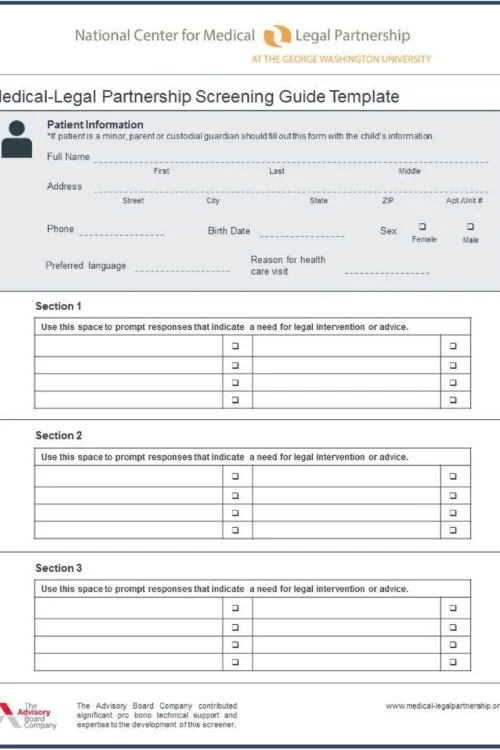
Screening Tool for MLP Legal Needs in Health Care Settings
The National Center for Medical-Legal Partnership, with pro bono support from The Advisory Board Company (ABC), reviewed 80 tools used by medical-legal partnerships across the country to screen for patients’ legal needs. We then developed a common screening tool that can be used by hospitals and health centers in a range of settings. The tool includes: a customizable screening guide template and patient authorization tools; a pick list of questions about specific health-harming legal issues and populations so that each medical-legal partnership can select questions related to the specific issues it addresses; and an evaluation form to help staff who administer the screener measure its success.
Keeping the Heat on for Children’s Health: A Successful Medical–Legal Partnership Initiative to Prevent Utility Shutoffs in Vulnerable Children
Working within a medical-legal partnership, an urban hospital-based pediatric practice standardized criteria for providers approving medical need utility certification requests. Authors compared prior-year utility certification requests and approvals (pre-intervention) with the intervention year for families who reported energy insecurity on a waiting-room screening questionnaire. Between the first and second years of the study, certification of medical need approvals increased by 65 percent, preventing utility shut-offs for 396 more families with vulnerable children.
Medical-Legal Strategies to Improve Infant Health Care: A Randomized Trial
A randomized control trial at Boston Medical Center, a large urban safety-net hospital, incorporated medical-legal partnership services into an intervention for families of healthy newborns receiving primary care. Low-income families assigned to the intervention group were found to have an increase in use of preventive health care and had greater access to concrete support. The results were published in Pediatrics.
Embedding Civil Legal Aid Services In Care for High-Utilizing Patients Using Medical-Legal Partnership
A one-year pilot study of high-need, high-use patients at Lancaster General Health showed that 95 percent of patients studied had 2-3 civil legal problems each. The study, published on the Health Affairs blog, also found that when those problems were addressed, inpatient and Emergency Department use dropped 50 percent, and overall health care costs went down 45 percent.
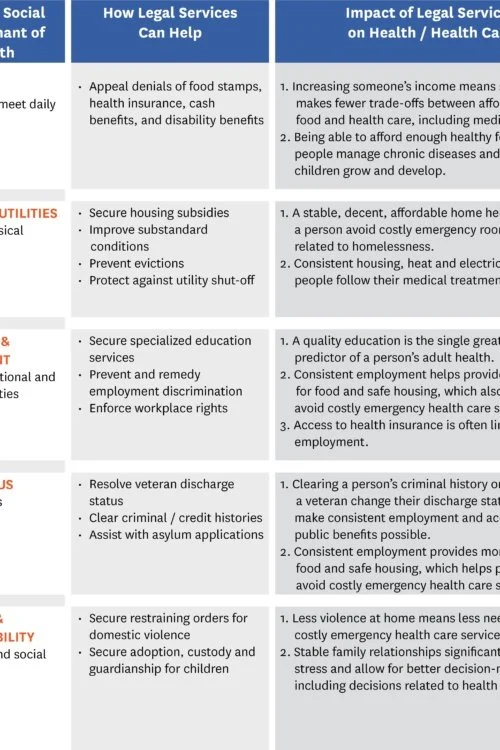
How Legal Services Help the Health Care System Address Social Needs: An I-HELP™ Messaging Chart
This chart shows some of the most common social problems faced by vulnerable communities, and how legal expertise and services can help mitigate their negative impact on health and health care. It can be used as a training tool and also to help communicate the value of an MLP. It is organized by the I-HELP™ acronym developed by the National Center for Medical-Legal Partnership to describe common health-related social and legal needs.
Framing Legal Care as Health Care Messaging Guide
The only way to make legal care visible and necessary to health care is to describe it in the words and values of that community. This guide helps civil legal aid practitioners message their work to healthcare audiences in order to build stronger cross sector medical-legal partnerships and to encourage investment in that work.