
Resources
We publish research, tools, and lessons learned to help healthcare and legal organizations build and operate medical-legal partnerships and to help funders and policymakers advance medical-legal partnership activities. You can search those resources in the library below.
The library also links to journal articles, authored both by National Center for Medical-Legal Partnership staff and MLP practitioners and researchers from the field, that highlight ways medical-legal partnerships have improved patient health and well-being, the healthcare workforce, and healthcare delivery. A list of these articles with summaries are also available on the Peer-Reviewed Research page.
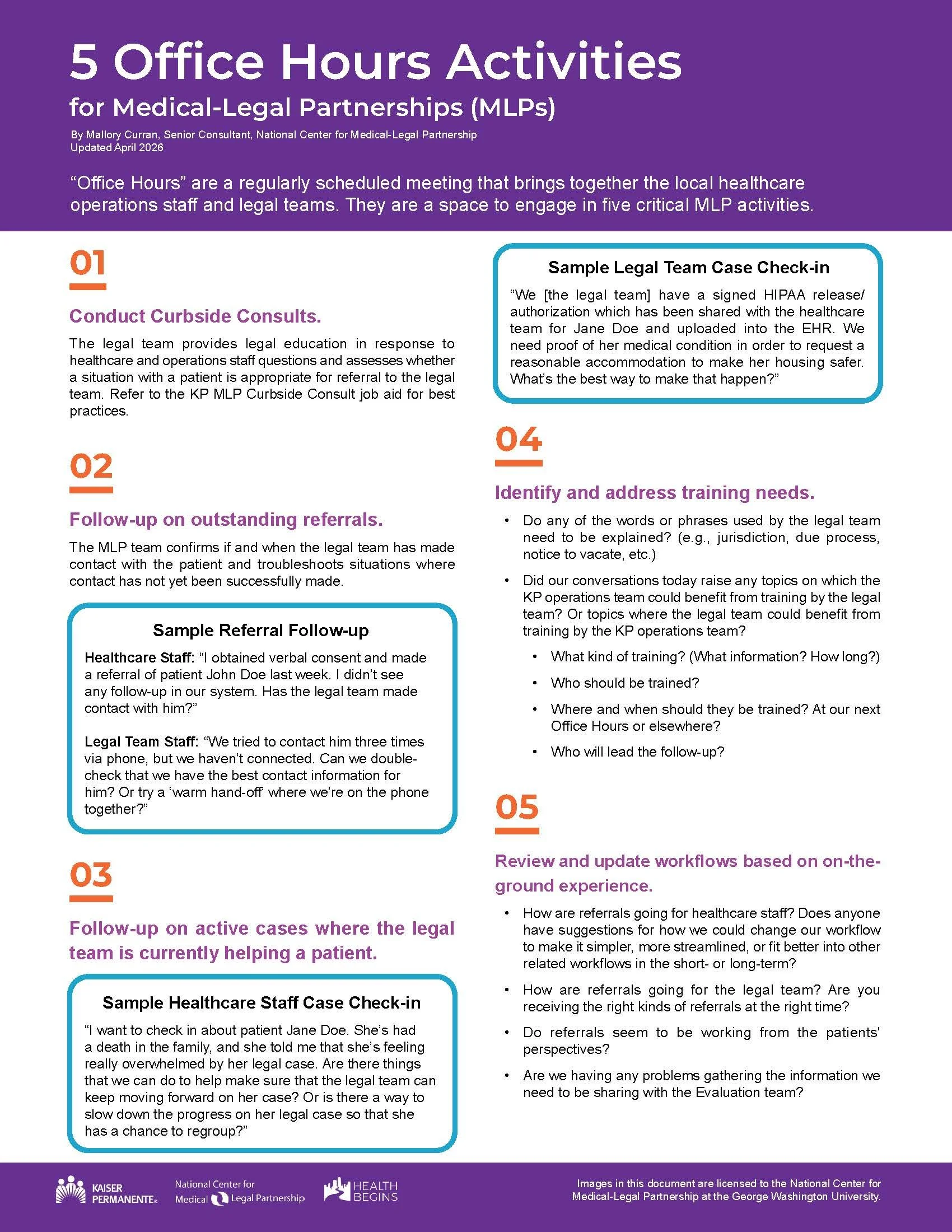
5 Activities for Medical-Legal Partnership Office Hours
This job aid provides an overview of Medical-Legal Partnership Office Hours activities and a sample agenda to guide MLP site teams as they set up these sessions. It was created as part of the Kaiser Permanente (KP) Medical-Legal Partnership Initiative.
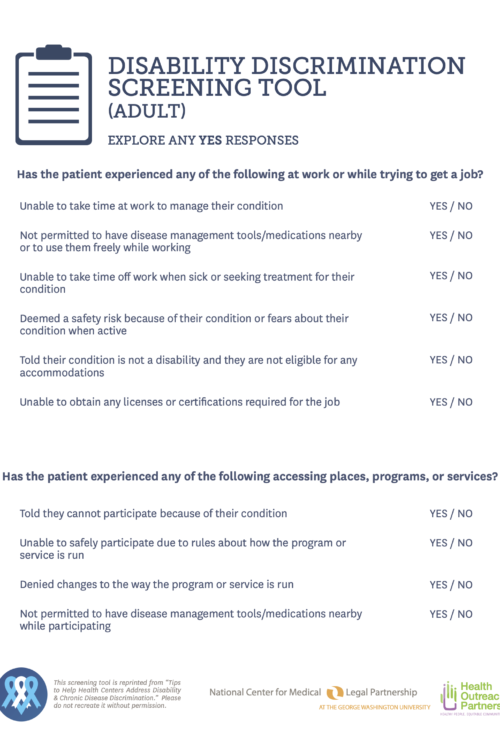
Screening Tool for Disability Discrimination
Two new screening tools help healthcare providers determine if a patient is experiencing discrimination based on a disability or chronic disease. There is one tool for adults and another for children and young adults (including those attending college).
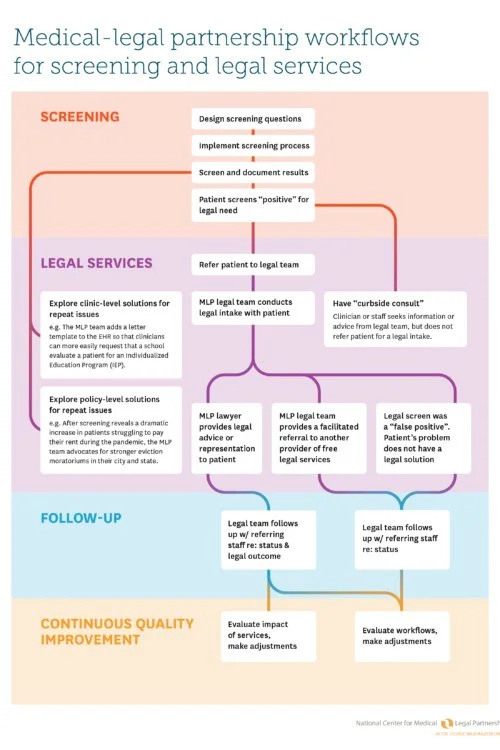
Medical-Legal Partnership Workflows For Screening And Legal Services
This graphic depicts a typical workflow for screening, legal services, follow-up, and continuous quality improvement activities at a medical-legal partnership (MLP). It can be used by healthcare and legal partners to plan for and improve their own MLP workflows.
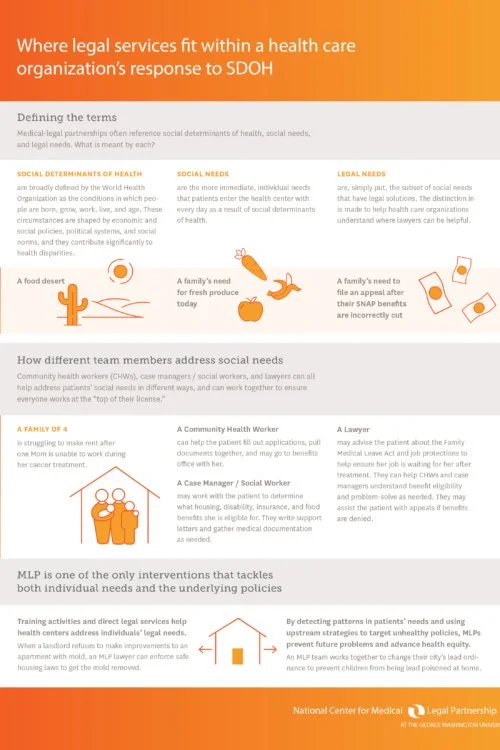
Where Legal Services Fit within a Healthcare Organization’s Response to SDOH
This infographic explains the difference between social determinants of health, social needs, and legal needs. It also demonstrates how different team members—community health workers, case managers / social workers, and lawyers—each help address patients’ social needs in different ways and where medical-legal partnership fits within a healthcare organization’s larger response to social determinants of health (SDOH).
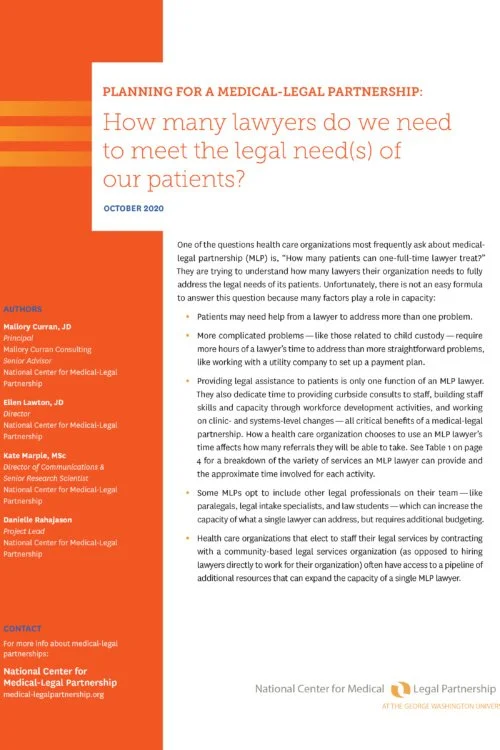
How Many Lawyers Do We Need To Meet The Legal Need(s) Of Our Patients?: An MLP Planning Tool
One of the questions healthcare organizations most frequently ask about medical-legal partnership (MLP) is, “How many patients can one-full-time lawyer treat?” They are trying to understand how many lawyers their organization needs to fully address the social and legal needs of its patients. This tool describes the factors that impact an MLP lawyer’s capacity and the types of activities—such as training, curbside consults, and legal representation of patients—that MLP lawyers engage in and the approximate time involved in each. It also offers three models estimating what one MLP lawyer could handle in a year based on the organization’s priorities.
Sample MLP Memorandum of Understanding (MOU) from a Florida Health Center
Before delivering medical-legal partnership services, health care and legal team members discuss their goals for the program, the responsibilities of each partner, and how they will measure success. When healthcare organizations choose to contract legal services from a community-based legal services organization (rather than hire lawyers directly to their staff), the decisions partners make should be documented in a Memorandum of Understanding (MOU). This resource is a sample MLP MOU from Grace Medical Home, Inc., a Florida-based community health center, and Community Legal Services of Mid-Florida, Inc. Other organizations can use it as an example to get started on their own MOU.