
News from the National Center
This is where we share what is happening with the National Center for Medical-Legal Partnership such as new partnerships and funding, highlight changes in policies that impact medical-legal partnership work, and respond to events in the world.
AMA Urges Funding to Expand MLPs Across the U.S. to Address the Maternal Health Crisis
The U.S. leads developed countries in maternal mortality rates, disproportionately affecting Black and Native American/Alaska Native individuals. The American Medical Association (AMA) continues to address this crisis, advocating for enhanced medical-legal partnerships in their 2024 recommendations to tackle social determinants of health among pregnant and postpartum individuals.
The Administration for Children and Families awards $1.6 million for Medical-Legal Partnerships Plus Program
The Administration for Children and Families at the U.S. Department of Health and Human Services announced today $1.6 million for Medical-Legal Partnerships Plus, a federally-funded demonstration program for medical-legal partnerships. The funding will help eight existing medical-legal partnerships increase their capacity to serve vulnerable families by providing comprehensive legal services and wrap-around social services to families with low incomes to address the root causes of health inequities.
Congress Introduces the Elder Justice Reauthorization and Modernization Act of 2023, Includes Support for MLPs
On April 19, 2023, the Elder Justice Reauthorization and Modernization Act of 2023 (H.R. 2718/S.1198), which reauthorizes the Elder Justice Act and dedicates new funding to programs that safeguard older adults and adults with disabilities from abuse, isolation, and neglect, was introduced in both chambers. The legislation directly appropriates $4.5 billion for new and existing EJA programs and activities through fiscal year 2027, including $500 million to support linkages to legal services and medical-legal partnerships.
Medical-Legal Partnership Recognized in North Carolina Medicaid Managed Care Application
The North Carolina Department of Health and Human Services recently released a request for proposals for Medicaid Managed Care Prepaid Health Plans. It states that in order to meet high-need Members’ unmet resource needs, Prepaid Health Plans are required at a minimum to, “Provide access to medical-legal partnerships for legal issues adversely affecting health, subject to availability and capacity of medical-legal assistance providers.”
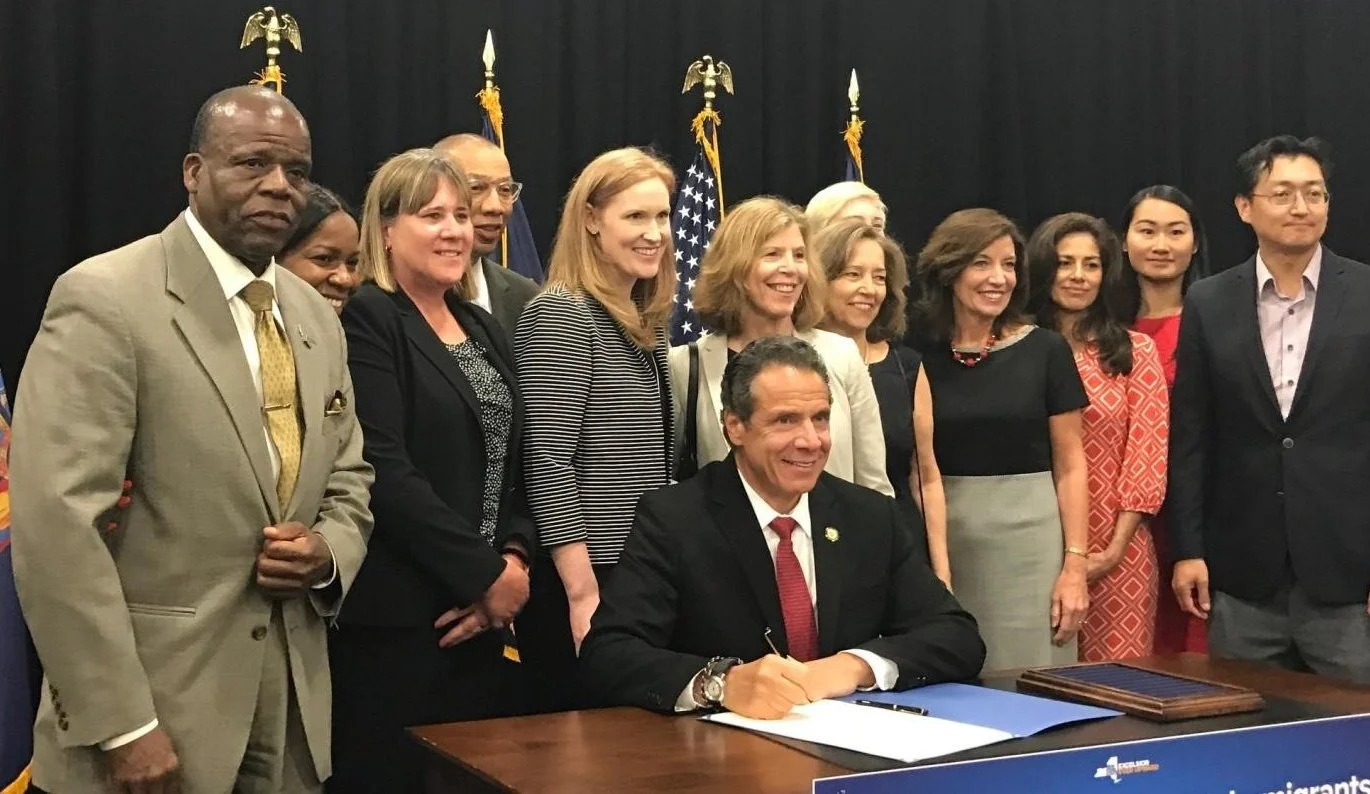
LegalHealth Plays Key Role in NY Law Allowing Immigrant Parents to Designate a Standby Guardian for their Children
On June 27, 2018, a new law was signed in New York that allows parents who are at risk of immigration enforcement because of their status to designate a Standby Guardian to care for their children in the event the parent is detained or deported. LegalHealth, a division of the New York Legal Assistance Group, along with the Family Center and pro bono partner Greenberg Traurig, LLP, led the community coalition that played critical roles in helping to both draft and lobby for the legislation.
House Introduces Lead-Safe Housing for Kids Act of 2018
Congressmen A. Donald McEachin (VA-04) and John Faso (NY-19) introduced the bipartisan Lead-Safe Housing for Kids Act of 2018 to help protect millions of children from the severe health and developmental problems associated with lead exposure. If passed, the law would require pre-rental risk assessments of all federal housing units before families move in, and gives families the right to move and maintain public assistance if a lead problem is found and the landlord does not mitigate the problem within 30 days of notification.
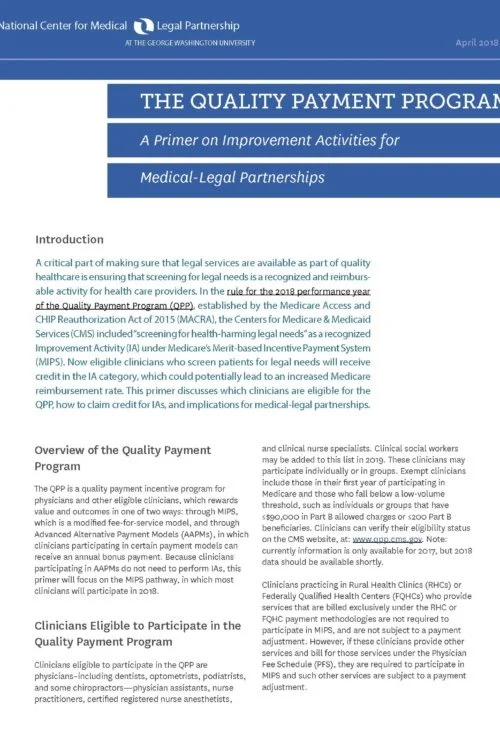
Rule Change: “Screening for Health-Harming Legal Needs” is an Improvement Activity Under CMS’ Quality Payment Program
In the rule for the 2018 performance year of the Quality Payment Program, established by the Medicare Access and CHIP Reauthorization Act of 2015 (MACRA), the Centers for Medicare & Medicaid Services included “screening for health-harming legal needs” as a recognized Improvement Activity (IA) under Medicare’s Merit-based Incentive Payment System. Now eligible clinicians who screen patients for legal needs will receive credit in the IA category, which could potentially lead to an increased Medicare reimbursement rate.
SAMHSA Grant Applications List MLP as Way to Help Address Substance Use Disorder
The federal Substance Abuse and Mental Health Services Administration (SAMHSA) provides grants to states through two types of block grants to support community mental health and substance use disorder prevention/treatment. Grants are awarded to state mental health agencies and single state agencies. As a follow up to the federal agency roundtable the National Center for Medical-Legal Partnership (NCMLP) hosted in September on the opioid crisis, NCMLP learned that the application for the 2018-2019 grants specifically states that mental health agencies may wish to develop medical-legal partnerships.
HRSA Recognizes Civil Legal Aid as an “Enabling Service,” Allows Health Centers to Use Funding for MLP
The Health Resources and Services Administration (HRSA), part of the U.S. Department of Health and Human Services, modified its funding eligibility rules to allow health centers to use federal “enabling services” funds to pay for on-site civil legal aid to help meet the primary care needs of the population and communities they serve.
Georgia is the Second State to Endorse Medical-Legal Partnership
On April 21, 2014, Governor Nathan Deal signed SB 352, a bill codifying medical-legal partnerships in the state of Georgia. The new law gives the Georgia Department of Community Health authorization to approve medical-legal partnerships that comply with standards and guidelines for the purpose of determining eligibility for grants.
New York is the First State to Endorse Medical-Legal Partnership
The state of New York amended its Public Health Law, section 22 to allow legal entities to register with the Department of Health as “health-related legal services programs.” This is a first-of-its-kind bill recognizing medical-legal partnership as an important health intervention.
Report from American Medical Association Board of Trustees Recommends Medical-Legal Partnerships
The Board of Trustees to the American Medical Association (AMA), the largest association of physicians and medical students in the United States, released a report that encourages physicians to develop medical-legal partnerships (MLPs) to help identify and resolve diverse legal issues that affect patients’ health and well-being.
American Academy of Pediatrics is First Professional Health Association to Endorse MLP
The American Academy of Pediatrics (AAP) became the first professional health association to formally endorse medical-legal partnership.
American Bar Association is First Professional Organization to Endorse MLP
The American Bar Association (ABA) became the first professional organization to formally endorse medical-legal partnership.