
Resources
We publish research, tools, and lessons learned to help healthcare and legal organizations build and operate medical-legal partnerships and to help funders and policymakers advance medical-legal partnership activities. You can search those resources in the library below.
The library also links to journal articles, authored both by National Center for Medical-Legal Partnership staff and MLP practitioners and researchers from the field, that highlight ways medical-legal partnerships have improved patient health and well-being, the healthcare workforce, and healthcare delivery. A list of these articles with summaries are also available on the Peer-Reviewed Research page.
An Interprofessional Approach to Teaching Advocacy Skills: Lessons from an Academic Medical–Legal Partnership
From 2016 - 2017, a medical-legal partnership in Washington, D.C. piloted a legislative advocacy training program for preclinical medical students designed to prepare them to meet with Capitol Hill representatives about a health justice issue. The pilot assessed the impact of adding an interprofessional education dimension to the program, which in this case involved engaging law faculty and students to help the medical students understand and navigate the federal legislative process and prepare for their meetings. Results from the pilot suggest that adding law and policy experts to advocacy-focused training programs can improve medical students’ advocacy knowledge and skills and increase their professional identity as advocates. The findings were published in the Journal of Legal Medicine.
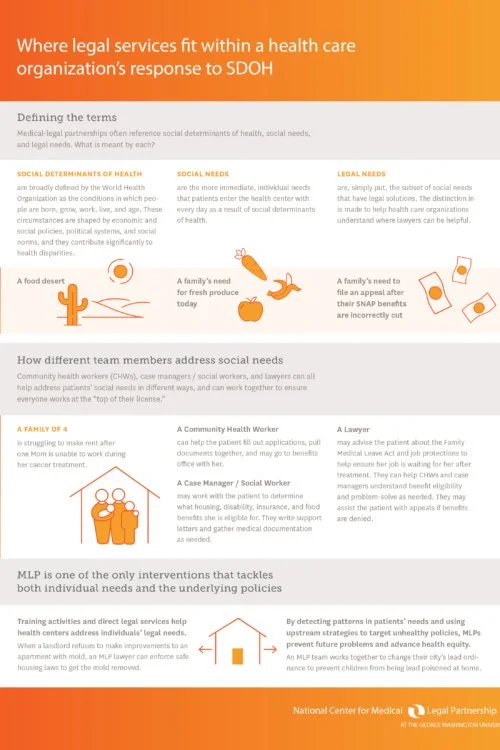
Where Legal Services Fit within a Healthcare Organization’s Response to SDOH
This infographic explains the difference between social determinants of health, social needs, and legal needs. It also demonstrates how different team members—community health workers, case managers / social workers, and lawyers—each help address patients’ social needs in different ways and where medical-legal partnership fits within a healthcare organization’s larger response to social determinants of health (SDOH).
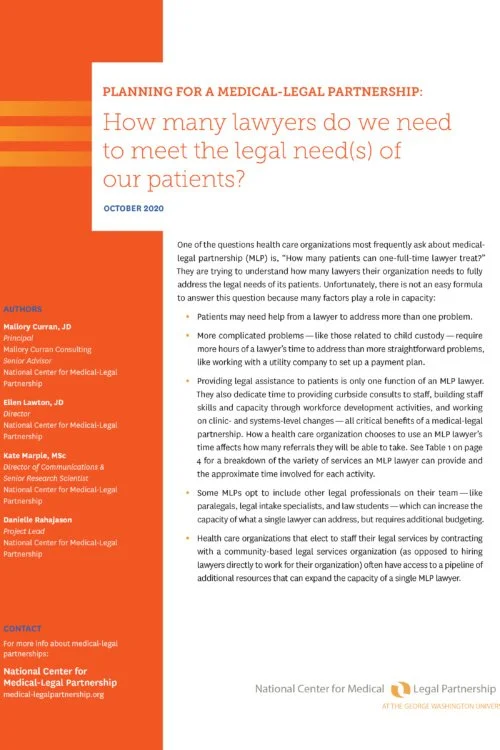
How Many Lawyers Do We Need To Meet The Legal Need(s) Of Our Patients?: An MLP Planning Tool
One of the questions healthcare organizations most frequently ask about medical-legal partnership (MLP) is, “How many patients can one-full-time lawyer treat?” They are trying to understand how many lawyers their organization needs to fully address the social and legal needs of its patients. This tool describes the factors that impact an MLP lawyer’s capacity and the types of activities—such as training, curbside consults, and legal representation of patients—that MLP lawyers engage in and the approximate time involved in each. It also offers three models estimating what one MLP lawyer could handle in a year based on the organization’s priorities.
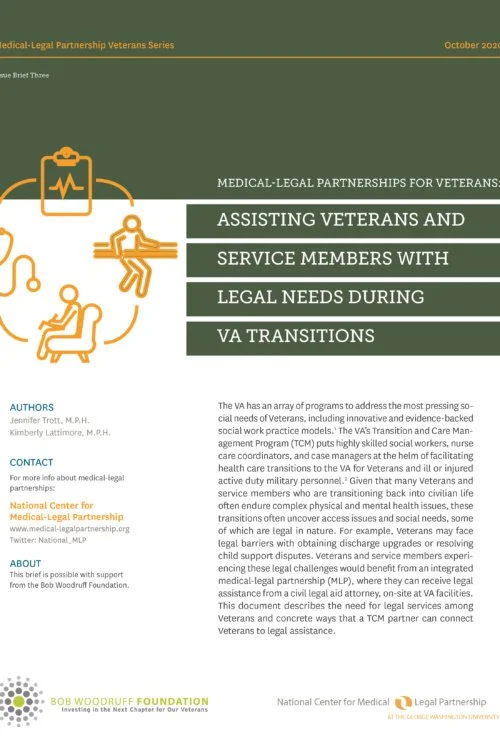
Assisting Veterans and Service Members with Legal Needs During VA Transitions
This issue brief describes the need for legal services among Veterans and concrete ways that a VA Transition Care Management Program (TCM) can connect Veterans to legal assistance, including medical-legal partnerships.
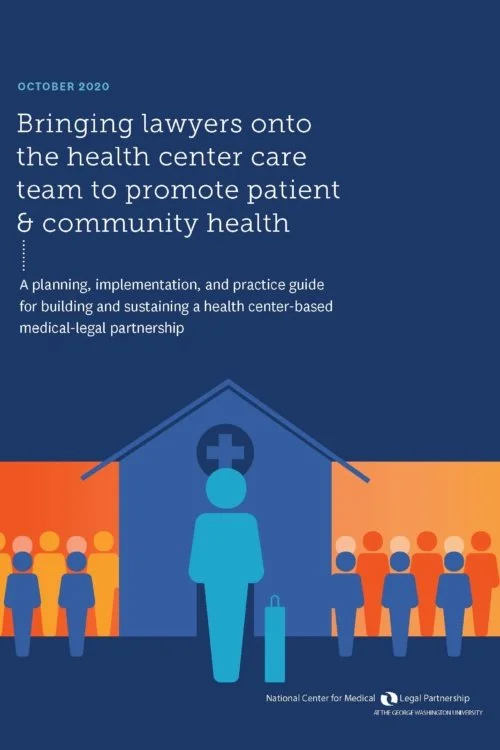
A Planning, Implementation, and Practice Guide for Building and Sustaining a Health Center-Based MLP
This toolkit provides the health center community information and resources to start, strengthen, and sustain a medical-legal partnership (MLP). Much of the guidance and resources are applicable to MLP teams in other healthcare settings.
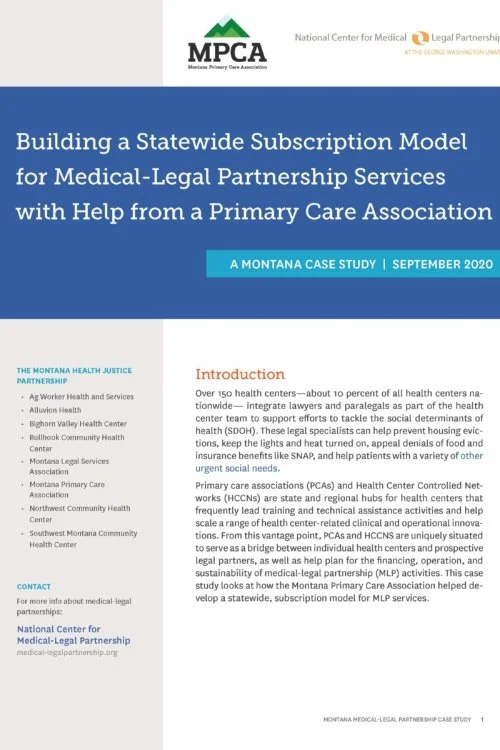
Building a Statewide Subscription Model for MLP Services in Montana with Help from a Primary Care Association: A Montana Case Study
Primary care associations and Health Center Controlled Networks are uniquely situated to serve as a bridge between individual health centers and prospective legal partners, as well as help plan for the financing, operation, and sustainability of medical-legal partnership (MLP) activities. This case study looks at how the Montana Primary Care Association helped develop a statewide subscription model for MLP services.