
Resources
We publish research, tools, and lessons learned to help healthcare and legal organizations build and operate medical-legal partnerships and to help funders and policymakers advance medical-legal partnership activities. You can search those resources in the library below.
The library also links to journal articles, authored both by National Center for Medical-Legal Partnership staff and MLP practitioners and researchers from the field, that highlight ways medical-legal partnerships have improved patient health and well-being, the healthcare workforce, and healthcare delivery. A list of these articles with summaries are also available on the Peer-Reviewed Research page.
Interprofessional Medical–Legal Education of Medical Students: Assessing the Benefits for Addressing Social Determinants of Health
In 2011, the authors implemented a four-session didactic interprofessional curriculum on medical–legal practice for third-year medical students at Morehouse School of Medicine. From 2011–2014, medical students participated in pre- and post-intervention surveys designed to determine their awareness of SDOH’s impact on health as well as their attitudes toward screening for SD0H issues and incorporating resources, including a legal resource, to address them. Post-intervention survey results indicated that students self-reported an increased likelihood to screen patients for SDOH issues and an increased likelihood to refer patients to a legal resource.
Information Sharing in Medical-Legal Partnerships: Foundational Concepts and Resources
In order to effectively facilitate patient access to the legal services that can ultimately improve health, it is critical that healthcare practitioners and legal service providers be able to share information. Medical-legal partnerships are designed to encourage and enable this communication, but the information privacy legal framework may still present obstacles, both real and perceived, to effective information sharing. This brief discusses numerous opportunities to share information within the boundaries of that legal framework and describes different consent models that are possible.
Bridging Health Disparity Gaps through the Use of Medical Legal Partnerships in Patient Care: A Systematic Review
This article is a review of observational studies, published from January 1993 -January 2016, to investigate the capacity of medical-legal partnerships to address legal and health disparities. The authors identified 13 articles for qualitative analysis from an initial pool of 355 records, four of which directly addressed the impact of MLP intervention on patient wellbeing and/or patient utilization of health care services.
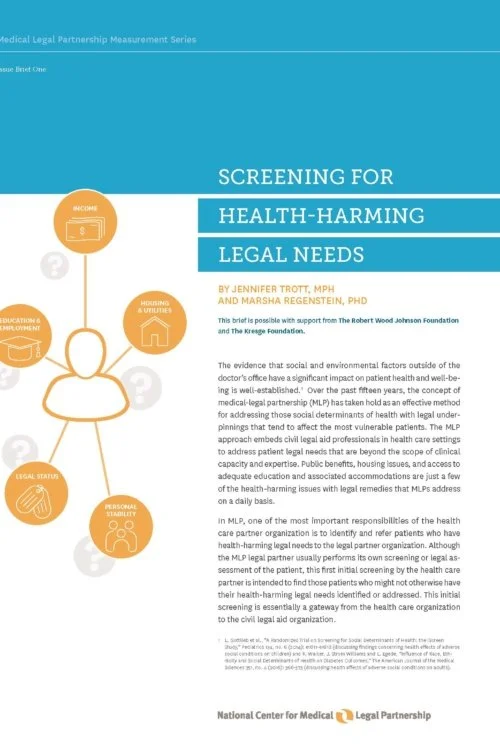
Screening For Health-Harming Legal Needs
This issue brief examines how 13 hospitals and health centers screen their patients for health-harming legal needs. It describes who gets screened and how, the way screening information is recorded and shared with legal partners, and lessons learned that can help other health care institutions more effectively screen their patients for legal needs and partner with civil legal aid agencies to address those needs.
The Medical–Legal Partnership Approach to Teaching Social Determinants of Health and Structural Competency in Residency Programs
Medical-legal partnership training helps residents develop structural competency and build the skills necessary to address barriers to health at the patient, institutional, and population levels. Through a case study, this Perspective in Academic Medicine explores how residents can address health-harming legal needs working in partnership with interprofessional health care teams that include lawyers, and illustrates how such MLP experiences can relate to competency-based Milestones that are applicable to training residents in all specialties.
Applying the Medical-Legal Partnership Approach to Population Health, Pain Points, and Payment Reform
This issue brief examines two examples of payment reform pain points felt by healthcare institutions adapting to new reimbursement models and the treatment of those pain points through collaboration with medical-legal partnerships (MLPs). This is followed by recommendations on how an MLP can become part of those population health management teams that are revolutionizing health care one population at a time, and the advantages of doing so, both for the healthcare institution and for the sustainability of the MLP approach.