
Resources
We publish research, tools, and lessons learned to help healthcare and legal organizations build and operate medical-legal partnerships and to help funders and policymakers advance medical-legal partnership activities. You can search those resources in the library below.
The library also links to journal articles, authored both by National Center for Medical-Legal Partnership staff and MLP practitioners and researchers from the field, that highlight ways medical-legal partnerships have improved patient health and well-being, the healthcare workforce, and healthcare delivery. A list of these articles with summaries are also available on the Peer-Reviewed Research page.
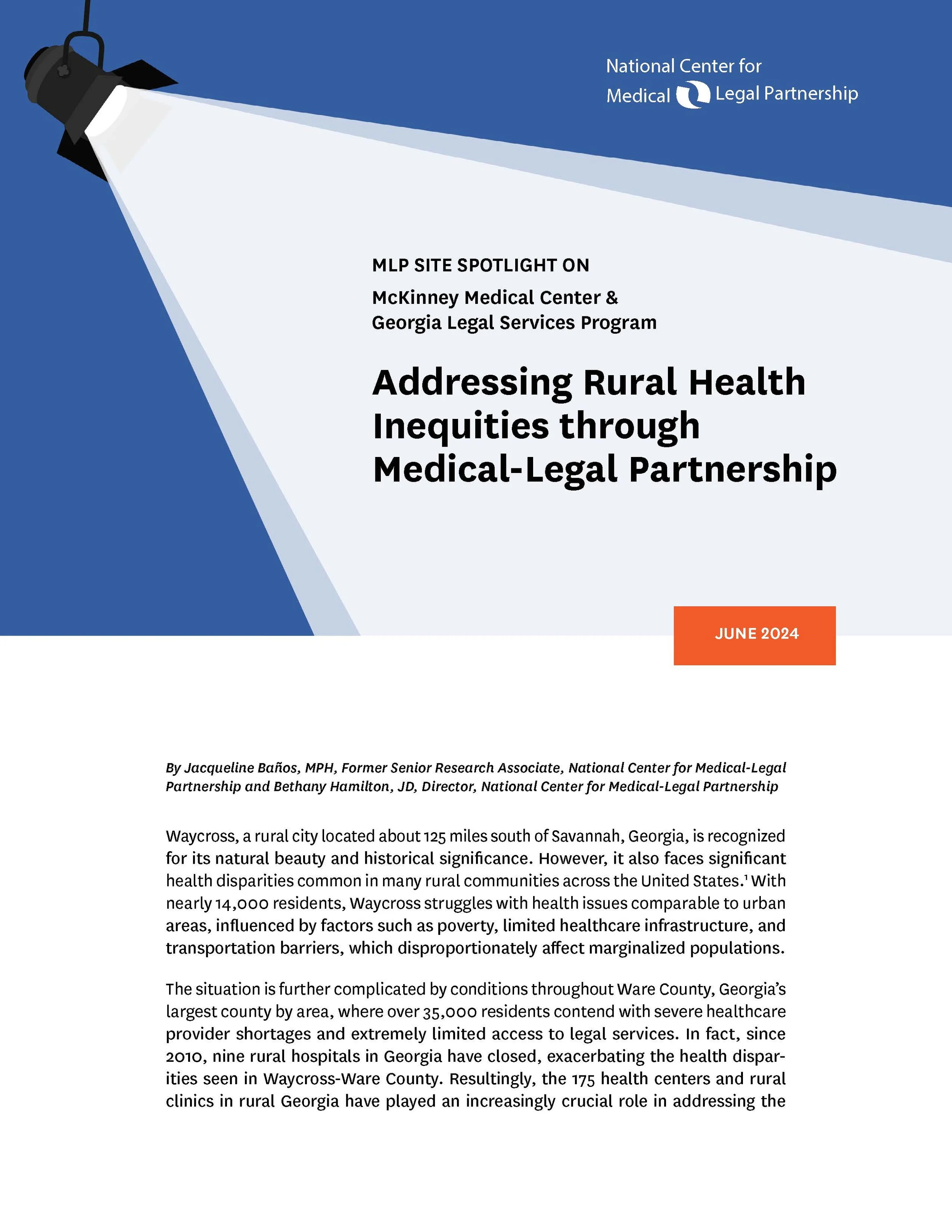
Addressing Rural Health Inequities through Medical-Legal Partnership: MLP Spotlight on McKinney Medical Center & Georgia Legal Services Program
This site profile features the work of the medical-legal partnership established by McKinney Medical Center and Georgia Legal Services Program. It describes the demographics of Waycross-Wayne County, Georgia, where the MLP is situated and who is served by the partnership. The profile also details how the partners meet the eight core components of an MLP established by the National Center for Medical-Legal Partnership.
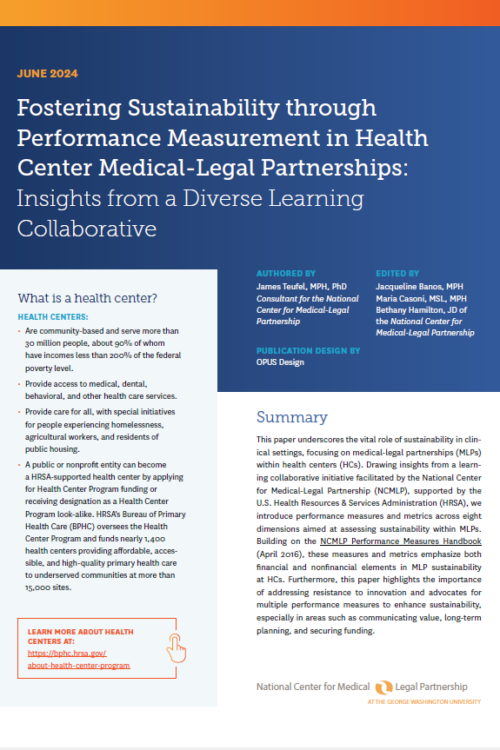
Fostering Sustainability through Performance Measurement in Health Center Medical-Legal Partnerships
This issue brief highlights the crucial role of sustainability for medical-legal partnerships (MLP), focusing on programs situated in health centers. It presents performance measures across eight dimensions to assess MLP sustainability. Building on the NCMLP Performance Measures Handbook (April 2016), these measures cover financial and non-financial aspects. They address resistance to innovation and emphasize the importance of communicating value, long-term planning, and securing funding.
Environmental Scan of Medical-Legal Partnerships in Health Centers
In 2022, the National Center for Medical-Legal Partnership and researchers at the George Washington University conducted an environmental scan of medical-legal partnerships (MLPs) operating in Federally Qualified Health Centers (FQHCs) and Look-Alike programs. This report provides up-to-date information on MLP implementation or planning at health centers. It explains how these health centers use MLP to identify patients with health-related legal needs and make legal services accessible for low-income and underserved communities. It also sheds light on requirements for the sustainability of MLPs in health centers.
The Academic Medical-Legal Partnership
This report defines how the academic medical-legal partnership (A-MLP) adheres to and deviates from the 8 core elements of a medical-legal partnership and formally recognizes three components unique to A-MLP. Specifically, the team finds that A-MLPs focus on 1) educating pre-professional learners; 2) intentionally creating interprofessional learning environments; and 3) contributing to the evidence base for the MLP model as a health equity intervention.

Increasing Capacity to Address Health, Justice & Equity Through Partnerships
Supporting the millions of survivors of domestic/intimate partner violence, human trafficking, and exploitation, requires an intentional and immediate shift away from professional silos and towards multidisciplinary, collaborative health, justice, and equity approaches. This guide helps health centers, domestic violence programs, and civil legal aid organizations leverage their respective skill sets to close access gaps by addressing survivors’ myriad of health and social needs, eliminate risk factors through prevention programs, and improve overall outcomes for individuals and communities.
Connecting Community Health Centers & Courts to Improve Behavioral Health of People & Communities
As an exploration of the intersection of health and justice, this issue brief offers nine recommendations of how health centers and courts can better support the behavioral health of justice-involved people. It proposes ways in which these organizations can collaborate and ultimately foster the next phase of the medical-legal partnership movement, bringing the healthcare provider into the legal context and expanding the pool of potential legal services providers.