
Resources
We publish research, tools, and lessons learned to help healthcare and legal organizations build and operate medical-legal partnerships and to help funders and policymakers advance medical-legal partnership activities. You can search those resources in the library below.
The library also links to journal articles, authored both by National Center for Medical-Legal Partnership staff and MLP practitioners and researchers from the field, that highlight ways medical-legal partnerships have improved patient health and well-being, the healthcare workforce, and healthcare delivery. A list of these articles with summaries are also available on the Peer-Reviewed Research page.
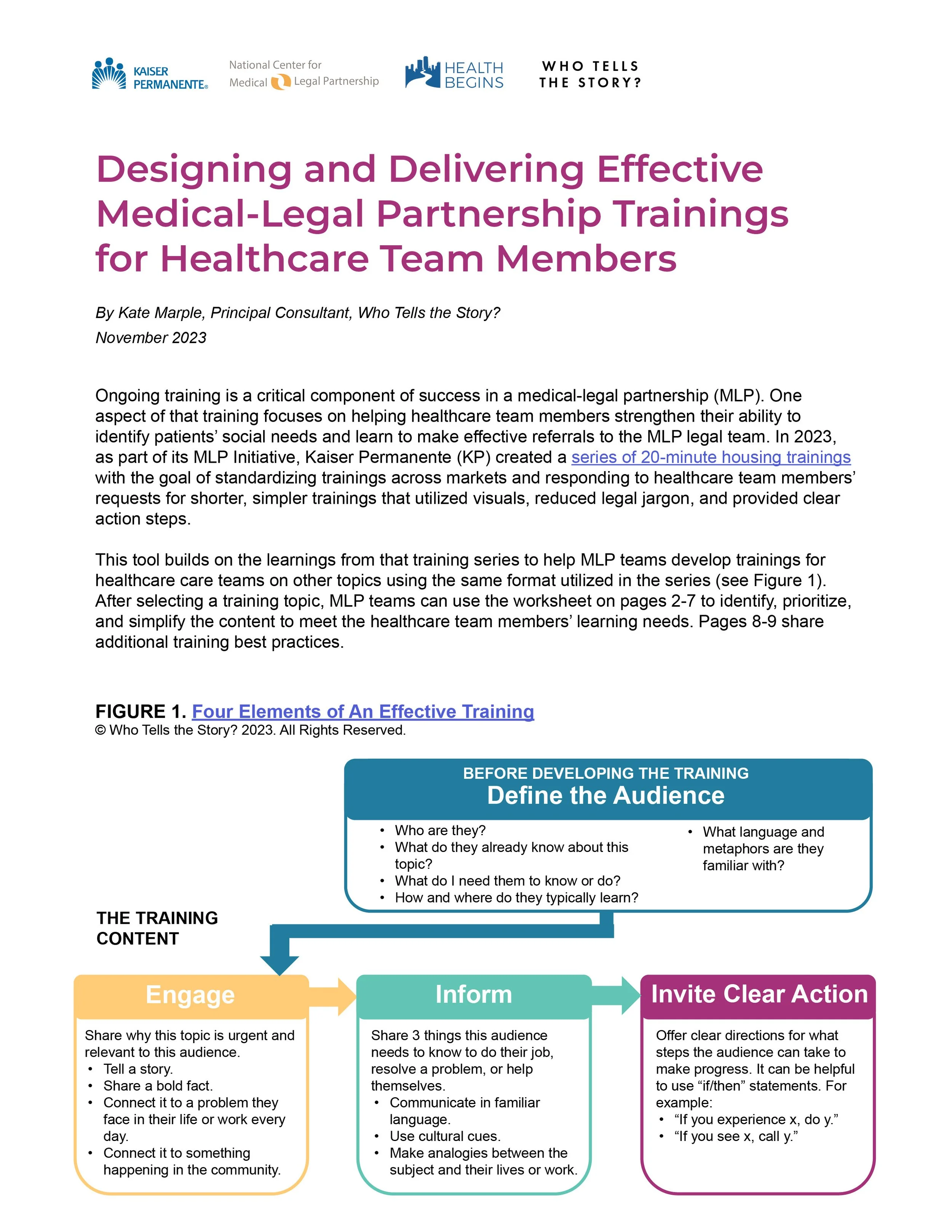
MLP Housing Trainings for Healthcare Teams
As part of regular medical-legal partnership practice, legal team members train healthcare team members’ about specific health-related legal topics to increase and improve referrals to medical-legal partnership legal partners. A series of housing trainings for healthcare providers were created for the Kaiser Permanente (KP) Medical-Legal Partnership Initiative. While initially created to train KP front-line healthcare staff, these trainings can be easily adapted and used by any MLP.
Making the Case for Medical-Legal Partnerships: A Review of the Evidence
The National Center for Medical-Legal Partnership has published three comprehensive literature reviews that offer an in-depth analysis of peer-reviewed research on medical-legal partnerships (MLPs). They capture the evolution and growing impact of MLPs across healthcare systems from 1977 - 2024.
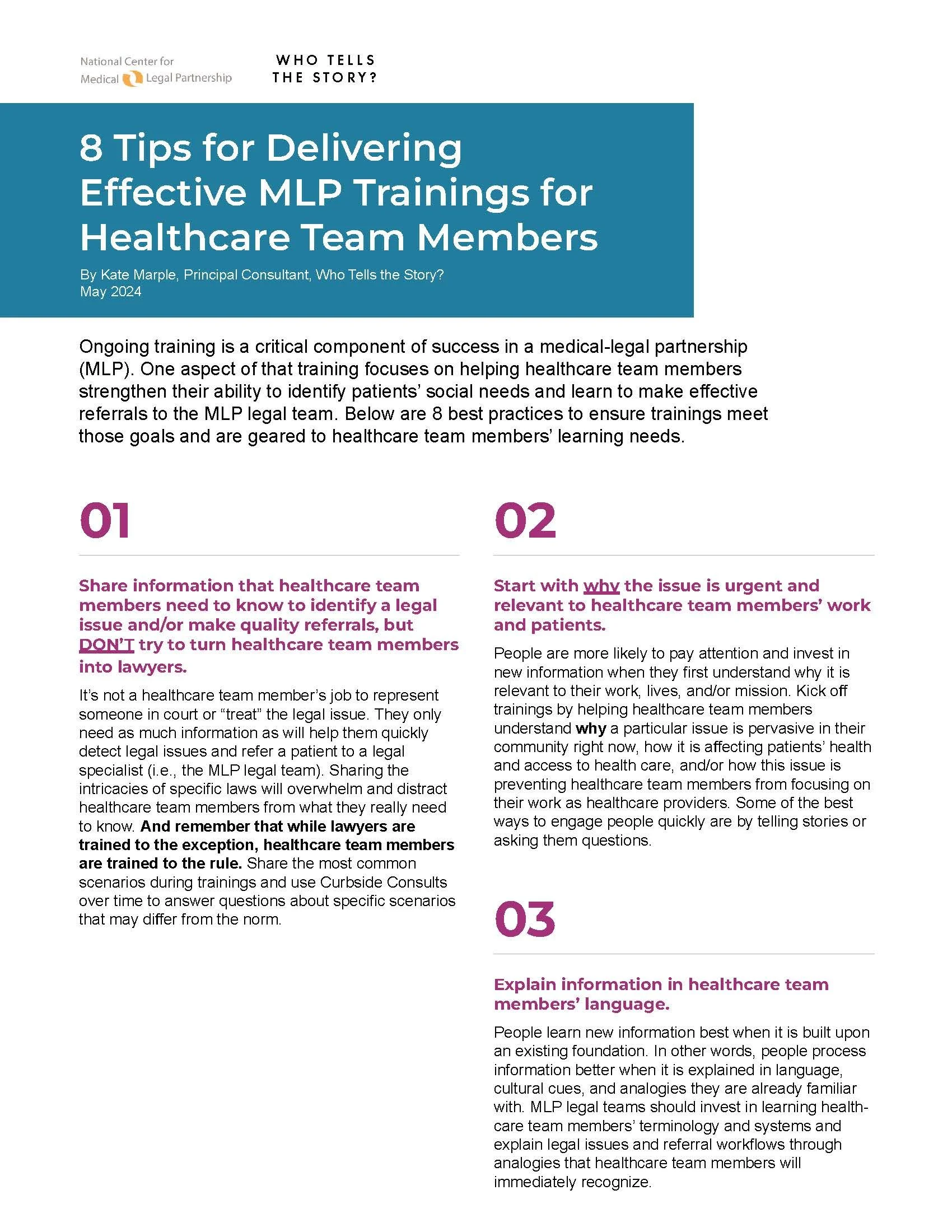
8 Tips for Effective MLP Trainings for Healthcare Team Members
This resource outlines best practices for training front-line care healthcare staff on medical-legal partnership topics. It was created as part of the Kaiser Permanente (KP) Medical-Legal Partnership Initiative.
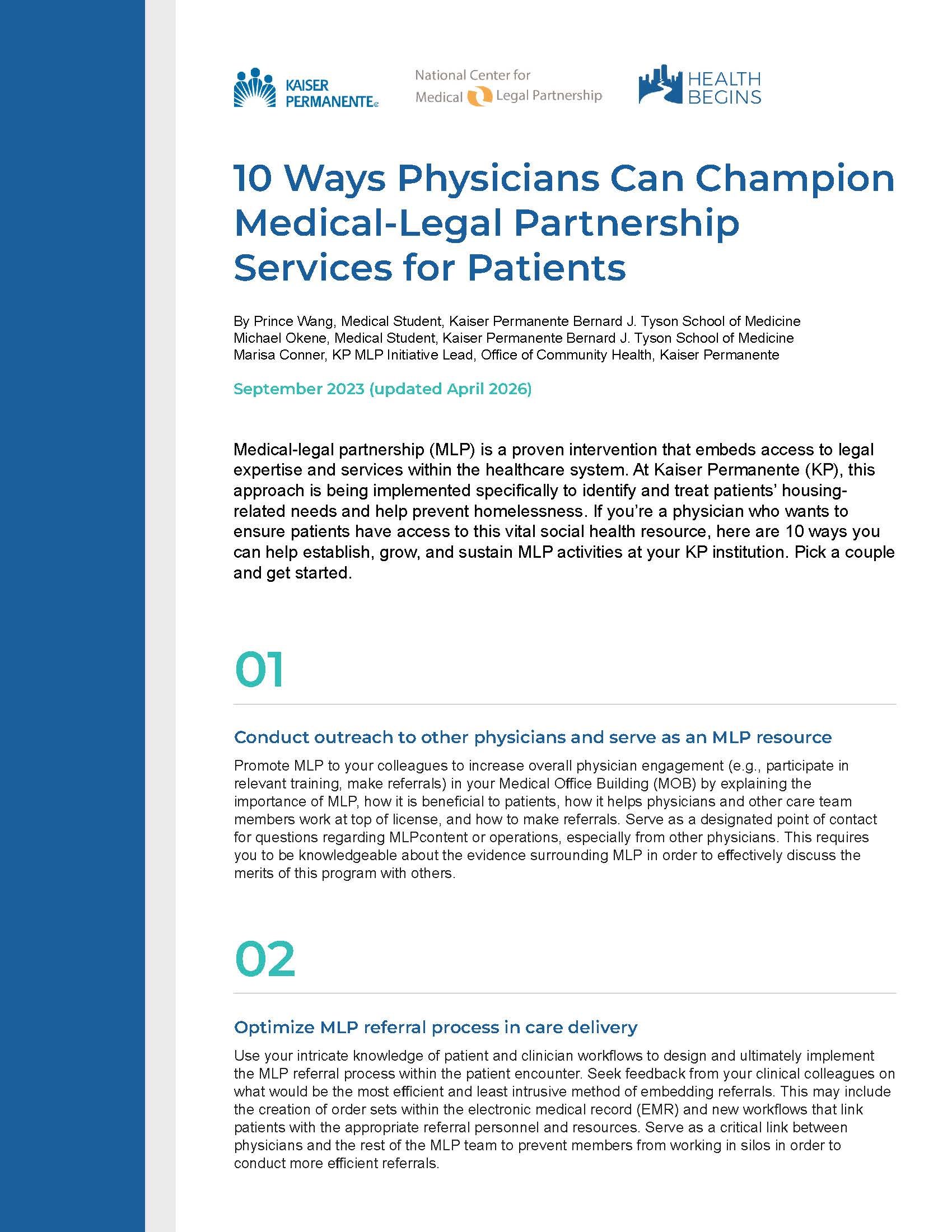
10 Ways Physicians Can Champion MLP Services for Patients
For physicians who want to ensure patients have access to medical-legal partnership services at their healthcare site, this job aid offers 10 ways they can help establish, grow, and sustain medical-legal partnership activities. This job aid can be adapted to work with other types of clinical leaders. It was created as part of the Kaiser Permanente (KP) Medical-Legal Partnership Initiative.
Impacts of a Medical-Legal Partnership on Clinical Capacity to Address Social Determinants of Health
A 16-question survey was emailed to 532 providers in a health system in South Carolina. The survey assessed clinicians’ perception of their role in addressing SDOH needs, the MLP’s impact on their clinical capacity, and the MLP’s ability to remedy patient SDOH needs. Providers who had referred to the MLP indicated higher levels of agreement that SDOH screenings were part of their clinical responsibility and had higher levels of agreement regarding comfort levels for completing SDOH screenings. Geriatric providers reported higher levels of agreement that the MLP reduced clinician stress than pediatric providers. Findings were published in the Journal of Epidemiology & Community Health.
The Academic Medical-Legal Partnership
This report defines how the academic medical-legal partnership (A-MLP) adheres to and deviates from the 8 core elements of a medical-legal partnership and formally recognizes three components unique to A-MLP. Specifically, the team finds that A-MLPs focus on 1) educating pre-professional learners; 2) intentionally creating interprofessional learning environments; and 3) contributing to the evidence base for the MLP model as a health equity intervention.