
Resources
We publish research, tools, and lessons learned to help healthcare and legal organizations build and operate medical-legal partnerships and to help funders and policymakers advance medical-legal partnership activities. You can search those resources in the library below.
The library also links to journal articles, authored both by National Center for Medical-Legal Partnership staff and MLP practitioners and researchers from the field, that highlight ways medical-legal partnerships have improved patient health and well-being, the healthcare workforce, and healthcare delivery. A list of these articles with summaries are also available on the Peer-Reviewed Research page.
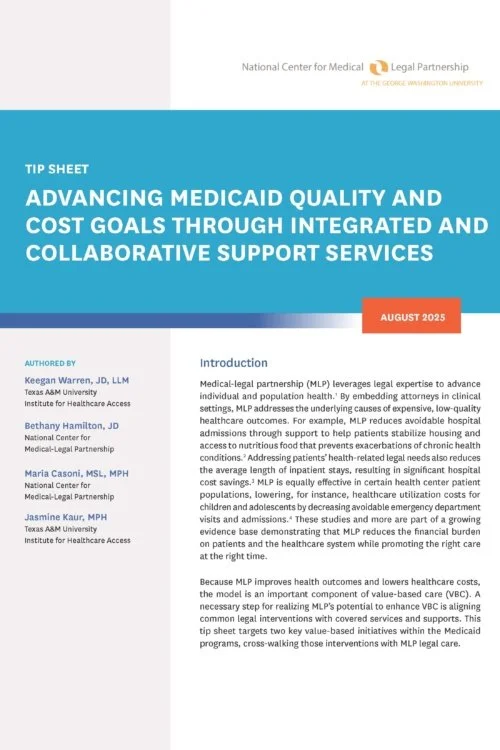
Advancing Medicaid Quality And Cost Goals Through Integrated And Collaborative Support Services
The National Center for Medical-Legal Partnership and Texas A&M’s Institute for Healthcare Access have released a new HRSA and Kaiser Permanente-supported tip sheet showing how MLP interventions can align with Medicaid to address patients’ health-related social needs. The resource offers strategies for integrating legal services into value-based care and highlights examples like North Carolina’s Healthy Opportunities Pilot.
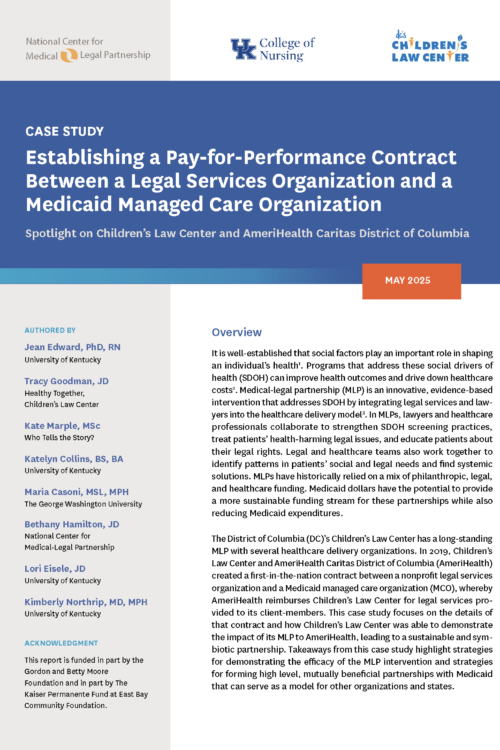
Establishing a Pay-for-Performance Contract Between a Legal Services Organization and a Medicaid Managed Care Organization
In Washington, D.C., Children’s Law Center partnered with AmeriHealth Caritas DC to establish a reimbursement model for legal services delivered to Medicaid enrollees. This case study explores how the medical-legal partnership (MLP) demonstrated its value, the data strategies that supported the partnership, and how the model can be replicated in other states.
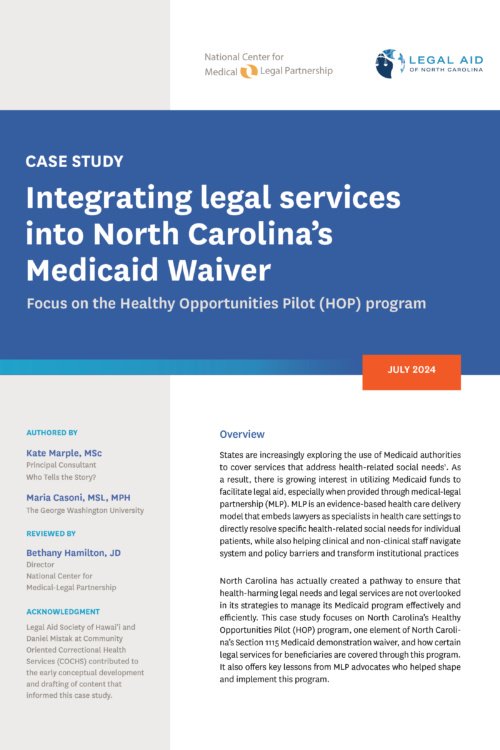
Integrating Legal Services into North Carolina’s Medicaid Waiver
This case study focuses on North Carolina’s Healthy Opportunities Pilot (HOP) program, one element of North Carolina’s Section 1115 Medicaid demonstration waiver, and how certain legal services for beneficiaries are covered through this program. It also offers key lessons from medical-legal partnership (MLP) advocates who helped shape and implement this program.
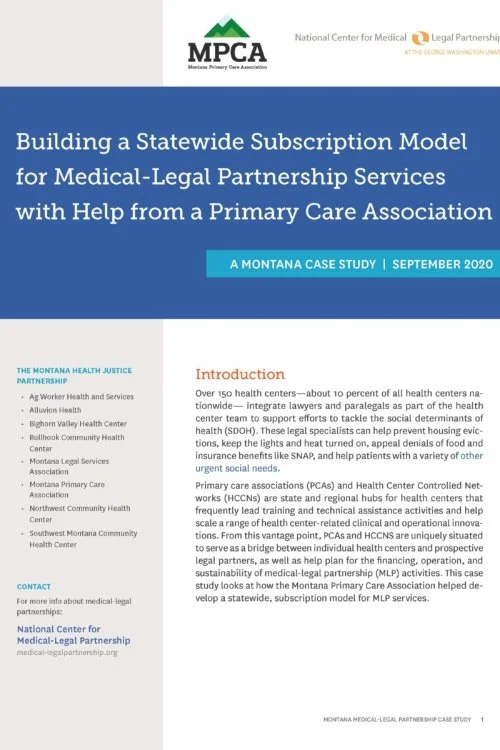
Building a Statewide Subscription Model for MLP Services in Montana with Help from a Primary Care Association: A Montana Case Study
Primary care associations and Health Center Controlled Networks are uniquely situated to serve as a bridge between individual health centers and prospective legal partners, as well as help plan for the financing, operation, and sustainability of medical-legal partnership (MLP) activities. This case study looks at how the Montana Primary Care Association helped develop a statewide subscription model for MLP services.
Financing Medical-Legal Partnerships: View from the Field
To date, nearly 350 health organizations nationwide have implemented medical-legal partnerships (MLPs). This fact sheet draws on national survey data from these organizations and their partnering legal organizations to describe programs’ average budgets as well as a variety of health, legal, and philanthropic funding streams that currently fund MLPs. It also discusses how MLPs are adapting to meet their funding challenges and highlights examples of programs implementing innovative Medicaid financing models to pay for MLP services.
Health Center-Based Medical-Legal Partnerships: Where They Are, How They Work, and How They Are Funded
Health centers represent the fastest growing sector for medical-legal partnership (MLP) adoption across the health care system; the number of health centers operating MLPs in 2016 represents nearly double the number in 2014. Today, 113 health centers operate MLPs, and 38 additional health centers are planning new MLPs. This issue brief describes how and where these partnerships operate and how state primary care associations are supporting these programs. It also discusses how health-center based MLPs are financed, with a spotlight on four states that integrate financing for legal services in Medicaid payment arrangements.